

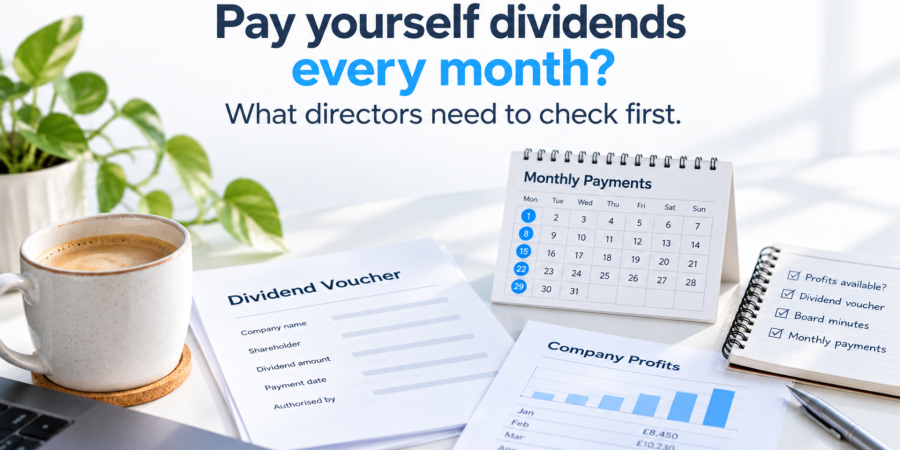
Can I Pay Myself Dividends Every Month From My Limited Company?
Many company directors want regular personal income without paying themselves entirely through salary. Monthly dividends can be possible, but they are not simply a second monthly wage.
By RiverView Portfolio · Reviewed 14 October 2026
Quick answer: can I pay myself a dividend every month?
Yes. A limited company can potentially pay dividends every month.
There is no rule requiring you to wait until the end of the financial year. Dividends can be paid at different times during the year.
But every dividend still needs to be supported by sufficient profits available for distribution and dealt with through the correct company process.
That means checking the numbers, declaring the dividend, keeping the appropriate minutes and preparing a dividend voucher rather than simply transferring the same amount to yourself every month and deciding later that it was a dividend.
Is it legal to pay myself dividends every month?
Yes, provided each dividend is lawful and your company has sufficient profits available for distribution.
The Insolvency Service confirms that dividends can be paid at any time during the year.
In many small owner-managed companies, payments made during the year are interim dividends.
Under the model articles for private companies limited by shares, directors may decide to pay interim dividends.
Your own company’s articles and share rights should still be checked because the exact position can differ where a company has amended articles or different classes of shares.
Read the official guidance on dividends for company directors and the model articles for private companies limited by shares.
Can I treat a monthly dividend like a monthly salary?
No. A dividend is a distribution to a shareholder. Salary is employment income paid to an employee or director through payroll.
The two payments are governed by different rules.
Salary.
Salary is paid for work performed and is normally processed through PAYE.
Income Tax and National Insurance can apply, and qualifying salary costs can generally reduce the company’s taxable profit.
Dividend.
A dividend is paid because you own shares in the company.
It can only be paid from sufficient profits available for distribution and is not a deduction from company profit for Corporation Tax purposes.
GOV.UK explains the distinction in its guidance on taking money out of a limited company.
How much profit does my company need before I can pay a monthly dividend?
Your company needs enough accumulated, realised profits available for distribution after accumulated realised losses and previous distributions have been taken into account.
This is different from simply looking at the balance in the company bank account.
Under section 830 of the Companies Act 2006, distributions can only be made from profits available for that purpose.
Broadly, those are accumulated realised profits, less accumulated realised losses, after allowing for amounts already used by previous distributions.
Does my company need to make a profit every single month before I take a dividend?
No. The test is not simply whether this month’s trading made a profit. The company can potentially use accumulated realised profits from earlier periods that remain available for distribution.
For example, a company may have built up substantial retained profits over previous years.
A quieter or loss-making month does not automatically mean no dividend can be paid if sufficient distributable reserves remain overall.
Equally, a very profitable month does not automatically mean every pound of that month’s cash can safely be distributed.
You still need to consider accumulated losses, Corporation Tax and previous dividends.
Do I need management accounts before paying myself a monthly dividend?
You need reliable financial information capable of supporting the dividend. Up-to-date bookkeeping or management accounts can therefore be particularly important where dividends are being paid regularly.
Company law requires a distribution to be justified by reference to relevant accounts.
Normally this begins with the company’s last annual accounts. Where those accounts do not support the proposed distribution, interim accounts may potentially be used where the statutory requirements are met.
Section 836 of the Companies Act 2006 explains the use of relevant accounts when justifying a distribution.
Regular bookkeeping makes it much easier to see whether the company can continue supporting the payments.
Do I need dividend paperwork every month?
Yes. Regular payments do not remove the normal dividend paperwork requirements.
GOV.UK says that to pay a dividend, a company must hold a directors’ meeting to declare it and keep minutes of that meeting, even where there is only one director.
For each dividend payment, the company must also prepare a dividend voucher showing:
- the date;
- the company name;
- the shareholder or shareholders receiving it; and
- the amount of the dividend.
A copy should be given to the recipient and retained with the company’s records.
See GOV.UK’s guidance on dividend meetings and vouchers.
Can I set up a standing order to pay myself the same dividend every month?
You can physically automate a bank transfer, but the standing order itself does not make the payment a valid dividend.
This is where regular monthly dividends can start looking too much like salary.
If £2,000 simply leaves the company on the first of every month regardless of how the business is performing, there is a risk that nobody is checking whether sufficient distributable profits still exist.
The safer approach is to review the company’s current position and formally approve each dividend before treating the payment as such.
The amount does not have to be identical every month. It can change according to the company’s available profits and your wider circumstances.
What happens if the company makes a loss after I have already taken monthly dividends?
A later trading loss does not automatically make an earlier dividend unlawful if that earlier dividend was properly supported when it was paid. But the loss can reduce or remove the profits available for future dividends.
The important issue is whether the distribution was justified using the relevant financial information at the time.
If performance deteriorates, you should therefore reassess the monthly dividend rather than continuing to pay the same amount automatically.
What happens if I pay myself monthly dividends but there is not enough profit?
If the company does not have sufficient profits available to support the dividend, the payment can become an unlawful or unsupported distribution.
The Insolvency Service says dividends paid without sufficient profits will usually need to be treated as a director’s loan and repaid.
This can then create further tax and reporting issues depending on the amount and how long the balance remains outstanding.
Example: can I take a £2,000 dividend every month?
£2,000 per month = £24,000 over a year.
Imagine an owner-director wants £2,000 each month from their company as dividends.
Over 12 months, that would mean total dividends of £24,000.
The company therefore needs sufficient accumulated realised profits available for distribution to support each payment as it is made.
Suppose the company begins the period with £18,000 of profits available for distribution and then generates further profits during the year.
If current figures continue to support the payments, monthly dividends may be possible.
But if trading deteriorates, losses arise or earlier distributions use up the available reserves, the company should reduce or stop later dividends rather than continuing the £2,000 automatically.
The example is deliberately simplified. Actual distributable profits depend on the company’s accounts, realised profits and losses, tax position, previous distributions and other relevant adjustments.
How are monthly dividends taxed?
Dividend Tax is based on your dividend income across the tax year, not on each monthly payment receiving a fresh allowance.
For the 2026/27 tax year, the Dividend Allowance is £500.
Dividend income above the available allowance is taxed according to the relevant tax band.
| 2026/27 tax band | Dividend rate above the allowance |
|---|---|
| Basic rate | 10.75% |
| Higher rate | 35.75% |
| Additional rate | 39.35% |
Your dividends sit alongside your other income when your tax band is worked out.
Read the current GOV.UK guidance on Dividend Tax.
What if I already have a full-time job and take monthly dividends too?
Your employment income affects the rate at which your dividends may be taxed.
A PAYE salary may already have used your Personal Allowance and some or all of your basic-rate band before the company dividend is added.
That means somebody with substantial employment income can face a very different dividend tax position from a director whose company is their only income source.
Read: I Have a Full-Time Job and a Limited Company. How Should I Pay Myself?
Can I pay myself a dividend without paying the other shareholders?
Do not assume you can simply choose which shareholder receives a dividend. The company’s share rights and shareholdings matter.
GOV.UK says dividends must usually be paid to all shareholders.
The model articles also require dividends to be paid in accordance with shareholders’ respective rights.
Companies with different share classes can have different rights, but those arrangements need to be understood properly before dividends are declared.
If there are several shareholders, do not simply copy the payment pattern used by a one-person company.
Is it better to pay myself monthly dividends or a salary?
There is no universal answer. Salary and dividends have different company and personal tax consequences, so the right mix depends on your wider position.
Salary may help reduce taxable company profits but can involve PAYE and National Insurance.
Dividends do not attract National Insurance, but they can only be paid from sufficient distributable profits and are not deductible when calculating Corporation Tax.
Pension contributions and leaving some profit in the company may also form part of the decision.
What should I check before paying myself a dividend each month?
Treat each proposed dividend as a real company decision rather than an automatic withdrawal.
-
Update the bookkeeping.
Know what the company has actually earned and spent rather than relying only on the bank balance. -
Check profits available for distribution.
Consider accumulated realised profits, losses, Corporation Tax and previous dividends. -
Check the company’s cash needs.
A lawful dividend can still be a poor commercial decision if it leaves the company short of cash for tax, payroll or other commitments. -
Approve the dividend properly.
Record the directors’ decision and keep the appropriate minutes. -
Prepare the dividend voucher.
Record the date, company, shareholder and amount and keep a copy with the company records. -
Review your personal tax position.
Keep track of dividends received during the tax year alongside salary and other income.
What if I just transfer money whenever I need it and sort the dividends out later?
That is risky. A personal bank transfer does not automatically become a dividend just because you later decide to describe it that way.
The payment needs to have the correct legal and accounting basis.
If you regularly take money without checking profits or preparing the appropriate records, some withdrawals may instead end up in your director’s loan account.
The same principle applies where the company card is being used directly for personal spending.
Read: I Paid a Personal Bill From My Company Account. What Happens Now?

Want regular income from your company?
Dan Farthing · Managing Director
Monthly dividends can work well for some owner-managed companies, but they should not become an automatic transfer that nobody checks.
RiverView Portfolio can help you keep the company figures current, understand what profits are genuinely available and plan salary, dividends and other withdrawals around both the business and your personal position.
Talk to Dan and the RVP teamSo, can you pay yourself dividends every month?
Yes. Monthly dividends can be perfectly legitimate, but each dividend still has to satisfy the normal rules.
Do not treat them as twelve automatic salary payments.
Before each dividend, make sure the company has sufficient profits available for distribution and enough cash for its tax liabilities, operating costs and future plans.
Then record the dividend properly with the appropriate decision, minutes and dividend voucher.
If profits fall during the year, adjust future payments rather than continuing a fixed monthly amount regardless.
And remember that the tax on your dividends is based on your overall income for the year, not simply how often the company pays them.
Want to take regular dividends without guessing?
We can help you understand what profits are available, keep the company records up to date and plan regular salary and dividend payments around the company’s cash position and your personal tax circumstances.
Talk to RiverView PortfolioMonthly dividends from a limited company: frequently asked questions.
Can I pay myself dividends every month?
Yes. Dividends can be paid at different times during the year, including monthly, provided the company has sufficient profits available for distribution and each dividend is properly declared and recorded.
Is there a limit to how often a limited company can pay dividends?
There is no general rule limiting dividends to once or twice a year. The important restrictions concern available distributable profits, the company’s share rights and the correct dividend procedure.
Do I need a dividend voucher every month?
Each dividend payment should have the required records. GOV.UK says a dividend voucher should show the date, company name, shareholder receiving the dividend and the amount paid, with a copy retained by the company.
Do I need a directors’ meeting for every dividend?
GOV.UK says the company must hold a directors’ meeting to declare a dividend and keep minutes, even where there is only one director. Regular monthly payments therefore still need the appropriate company records.
Can I pay myself the same dividend amount every month?
Potentially, but only while the company’s available profits continue to support the payments. A fixed monthly amount should not continue automatically if losses or earlier distributions reduce the company’s distributable reserves.
Can I set up a standing order for monthly dividends?
A standing order can automate the bank transfer, but it does not itself make the payment a lawful dividend. The company still needs sufficient distributable profits and the appropriate dividend decision and records for each payment.
Does my company have to make a profit every month before paying a dividend?
No. A company may have accumulated realised profits from earlier periods that remain available for distribution. Current losses and previous dividends must still be taken into account when deciding what remains available.
What happens if profits fall after I have paid a dividend?
A later loss does not automatically make an earlier dividend unlawful if the earlier payment was properly justified when made. However, later losses can reduce the profits available for future dividends, so regular payments should be reviewed.
What happens if I take more dividends than the company can afford?
If there are insufficient profits available to support the dividend, the payment may be unlawful. The Insolvency Service says unsupported dividends will usually need to be treated as a director’s loan and repaid.
How much Dividend Tax do I pay in 2026/27?
The Dividend Allowance for 2026/27 is £500. Dividend income above the available allowance is taxed at 10.75% at the ordinary rate, 35.75% at the upper rate and 39.35% at the additional rate. The applicable rate depends on your overall income.
Do I get a £500 Dividend Allowance every month?
No. The £500 Dividend Allowance applies across the whole tax year, not separately to each dividend payment.
Are monthly dividends better than salary?
Not automatically. Salary and dividends have different Corporation Tax, Income Tax and National Insurance consequences. The appropriate mix depends on the company’s profits and cash requirements as well as your other personal income.