
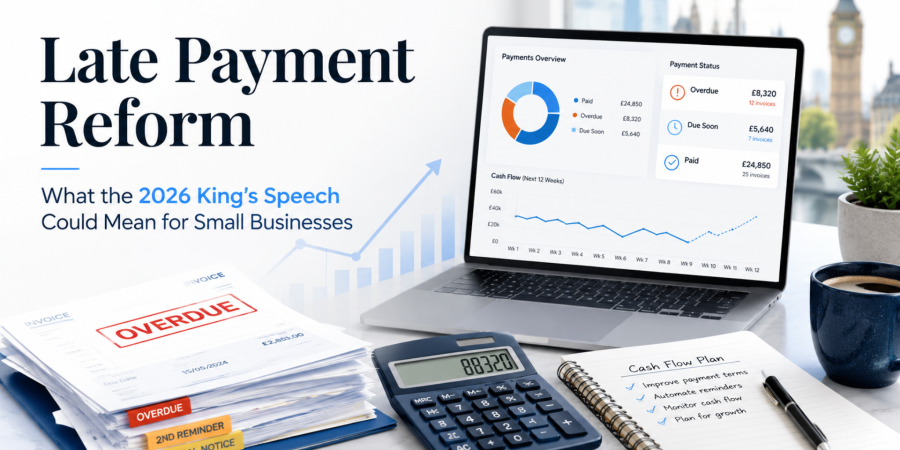
Late Payment Reform: What the 2026 King’s Speech Could Mean for Small Businesses
The 2026 King’s Speech confirmed plans for new legislation aimed at tackling late payments to small businesses. For SMEs, this could become one of the most practical business changes to watch over the coming months.
Late payment is not just an irritation. For many small businesses, it creates real pressure on cashflow, supplier relationships, payroll, tax payments and day-to-day decision-making.
When larger customers delay payment, smaller suppliers are often forced to absorb the problem. That can mean dipping into reserves, relying on overdrafts, delaying investment, or spending valuable time chasing money that should already have arrived.
The proposed Small Business Protections (Late Payments) Bill is intended to shift that balance. If introduced, it could give smaller firms stronger rights, create tougher consequences for persistent late payers, and make payment behaviour harder for larger companies to ignore.
Key point: this is not yet law. However, SMEs should treat it as a clear signal that payment terms, invoice processes and cashflow management are moving higher up the business agenda.
What was announced in the 2026 King’s Speech?
The King’s Speech set out the Government’s intention to introduce legislation to tackle late payments suffered by small businesses from larger customers.
The proposed reforms are expected to include:
- A maximum payment term of 60 days for large firms paying smaller suppliers
- Mandatory statutory interest on late payments
- Interest set at 8% above the Bank of England base rate
- Stronger powers for the Small Business Commissioner
- Potential financial penalties for persistent late payers
- New rules around invoice disputes
- Additional reporting requirements for larger companies
For small businesses, the direction of travel is clear. The Government wants to make it harder for larger organisations to use smaller suppliers as a source of informal credit.
Why late payment is such a serious issue for SMEs
Late payment can quietly damage a business long before it becomes a crisis.
A profitable business can still run into trouble if cash is not arriving on time. Sales may look strong, invoices may have been issued correctly, and the accounts may show profit. But if customers are taking too long to pay, the business can still struggle to meet its own commitments.
This matters because cashflow is often what determines how confidently a business can operate. It affects whether you can:
- Pay staff and suppliers on time
- Keep up with VAT, PAYE, Corporation Tax and other tax liabilities
- Invest in equipment, marketing or recruitment
- Manage seasonal peaks and troughs
- Avoid unnecessary borrowing
- Make clear decisions instead of reactive ones
Late payments also create a hidden administrative cost. Time spent chasing overdue invoices is time not spent winning new work, looking after customers, improving processes or growing the business.
What could mandatory late payment interest mean?
One of the most important proposed changes is mandatory statutory interest on late payments.
Under the proposals, commercial contracts would need to include a right to statutory interest, set at 8% above the Bank of England base rate. With Bank Rate currently at 3.75%, that would make the potential statutory late payment interest rate 11.75% if the calculation applied today.
That does not mean every small business should immediately start relying on interest charges as a commercial strategy. In practice, relationships still matter, and many business owners will want to preserve good customer relationships where delays are occasional or genuinely explained.
However, the proposed rules could give smaller suppliers more leverage when dealing with larger businesses that habitually pay late or use extended terms as standard practice.
Why payment terms need reviewing now
Even though the proposed reforms are not yet law, small businesses should not wait until the rules are final before reviewing their own position.
The businesses that benefit most from payment reform will usually be the ones that already have good processes in place. That means clear contracts, accurate invoices, prompt follow-up and reliable records.
If your business regularly deals with larger customers, now is a sensible time to review:
- Standard payment terms in your contracts and engagement letters
- How quickly invoices are raised after work is completed
- Whether invoices include all required details
- How overdue invoices are monitored
- Who is responsible for credit control
- Whether recurring late payers are being challenged
- How unpaid invoices are reflected in your cashflow forecasts
For many SMEs, the issue is not that customers never pay. The issue is that payment is inconsistent, unpredictable or too slow to support the way the business actually operates.
Invoice disputes may become harder to use as a delay tactic
Another important part of the proposed reform is the introduction of a statutory time limit for raising invoice disputes.
This could be significant. One common frustration for small businesses is when a customer raises a query late in the process, sometimes only after the payment deadline has passed. In some cases, that may be genuine. In others, it can feel like a tactic to delay payment.
A clearer deadline for disputes could encourage customers to raise issues earlier and reduce the number of invoices that sit unpaid while both sides argue over details that could have been addressed sooner.
For small businesses, this makes invoice accuracy even more important. The cleaner the invoice, the harder it is for a customer to justify delay.
What should small businesses do before the rules change?
The best response is not to wait for legislation and then rush to adapt. SMEs should use this moment to tighten their payment systems now.
Practical steps include:
- Reviewing your standard payment terms
- Making sure terms are agreed before work starts
- Issuing invoices promptly and accurately
- Adding clear payment due dates to every invoice
- Keeping written records of customer approvals and disputes
- Monitoring aged debt regularly
- Building overdue invoices into cashflow planning
- Reviewing whether persistent late payers are still commercially worthwhile
This is also a good time to look at your bookkeeping and management information. If your records are not up to date, you may not spot cashflow pressure until it has already become a problem.
Why this is also an accounting issue
Late payment is often treated as a sales or admin problem, but it has a direct accounting impact.
Poor payment behaviour can distort your understanding of how the business is performing. Turnover may look healthy, but if debtor days are rising, the business may be carrying more risk than the headline figures suggest.
This is why regular management accounts, debtor reviews and cashflow forecasting are so useful. They help business owners understand not just what has been invoiced, but what has actually been collected.
A business owner who understands their cash position can make better decisions on tax planning, recruitment, dividends, investment and borrowing.
The bigger message for SMEs
The proposed late payment reforms are welcome, but they should not be seen as a complete solution on their own.
Legislation may improve payment culture over time, but small businesses still need strong internal processes. Clear terms, accurate invoicing, active credit control and proper cashflow forecasting remain essential.
The businesses that will be best placed are those that know their numbers, understand their payment cycle and act early when customers fall behind.
If late payment is already affecting your cashflow, profitability or tax planning, now is the time to review it properly rather than hoping the new rules will solve the issue by themselves.
Need clearer cashflow and stronger business reporting?
RiverView Portfolio can help you review your numbers, understand your cashflow position and build better financial visibility into your business.
FAQs: Late payment reform 2026
What is the Small Business Protections (Late Payments) Bill?
The Small Business Protections (Late Payments) Bill is proposed legislation announced in the 2026 King’s Speech. It is intended to tackle late payments from larger businesses to smaller suppliers and improve payment culture across the UK.
Has the late payment reform become law yet?
No. The reforms have been announced as proposed legislation, but they have not yet completed the parliamentary process. Businesses should monitor developments and use this time to review their payment terms and cashflow processes.
What is the proposed 60-day payment cap?
The Government has proposed a 60-day cap on payment terms for large firms paying smaller suppliers. This is designed to stop larger organisations from imposing excessive payment terms on smaller businesses.
What interest could apply to late payments?
The proposed reforms include mandatory statutory interest on late payments, set at 8% above the Bank of England base rate. The exact amount would depend on the Bank Rate at the relevant time and how the final legislation is drafted.
How can SMEs prepare for the late payment changes?
SMEs should review their contracts, payment terms, invoicing process, credit control procedures and cashflow forecasting. The stronger your internal systems are, the easier it is to challenge late payment and manage working capital.
Why does late payment matter for tax planning?
Late payment can affect whether a business has enough cash available for VAT, PAYE, Corporation Tax and other liabilities. A business can be profitable on paper but still face cashflow pressure if invoices are not paid on time.