
Free HMRC Corporation Tax Filing Has Closed: What Small Companies Need To Do Now
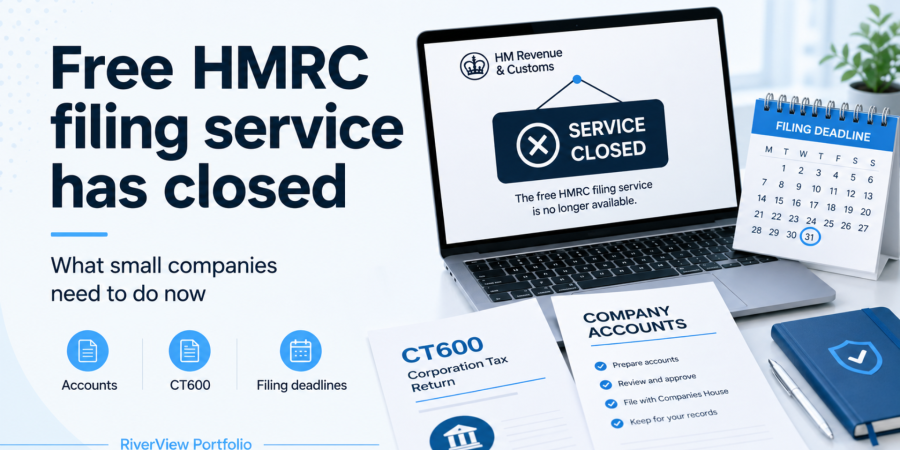
The free HMRC and Companies House joint online filing service has now closed.
For many small companies, this is a bigger change than it first appears.
The service, often used by smaller companies to file accounts and Corporation Tax returns together, closed on 31 March 2026. From 1 April 2026, companies that previously used it need to file in a different way.
HMRC guidance now states that companies should use commercial software to file annual accounts and Company Tax Returns with HMRC.
For small company directors, this is another sign that tax and compliance are becoming more digital, more software-led, and less forgiving of last-minute admin.
What has changed?
The joint online service allowed companies to file their annual accounts and Company Tax Return at the same time with Companies House and HMRC.
That option has now gone.
Companies House confirmed that the service would close on 31 March 2026, and from 1 April 2026, companies would need to use software to file their Company Tax Return with HMRC.
HMRC’s current guidance says companies that previously used the online service should now use commercial software to file annual accounts and Company Tax Returns.
The software must be able to handle the relevant parts of the Company Tax Return, including the CT600, Corporation Tax computation and company accounts.
Why does this matter for small companies?
For larger companies, this change may not feel dramatic. Many already use accountants or commercial filing software.
But for smaller limited companies, micro-entities, flat management companies, dormant companies and owner-managed businesses, this could create problems if they only realise at filing time.
The risk is simple: you sit down to file using the old method, only to find the service is no longer available.
That could mean:
- having to find suitable software at short notice
- not knowing which filing route applies to your company
- struggling with accounts format requirements
- making errors in your Corporation Tax computation
- missing filing deadlines
- receiving penalties for late filing
This is not a change directors should leave until the week before the deadline.
Can companies still file accounts directly with Companies House?
In some cases, yes.
Companies House guidance shows that some types of accounts may still be filed through routes such as software, WebFiling or the Find and Update Company Information service, depending on the type of accounts being filed.
For example, micro-entity accounts and some dormant accounts may have filing options through WebFiling, but many other account types require software.
The important point is that Companies House filing and HMRC Corporation Tax filing are not the same thing.
A company may be able to file certain accounts with Companies House through one route, but still need suitable software for the Company Tax Return submitted to HMRC.
This is where small businesses can get caught out.
What should directors do now?
If your company previously used the free HMRC and Companies House filing service, you should review your position now, not when your deadline is approaching.
1. Check your next filing deadline
Start with the basics.
Check when your next accounts are due to Companies House and when your Corporation Tax return is due to HMRC.
These deadlines are separate, and missing either can create unnecessary penalties, admin and stress.
2. Confirm how your accounts will be filed
Do not assume the old process has simply moved somewhere else.
You need to know whether your accounts can be filed through Companies House online services, whether they need to be filed using software, and whether your Corporation Tax return can be submitted properly to HMRC.
HMRC provides a list of commercial software suppliers, but businesses still need to check that the software is suitable for the return they need to file.
3. Save old filing records
Companies House previously recommended downloading and saving at least three years of accounts filings, because previous filings on the old service would no longer be accessible after 1 April 2026.
If you relied on the old system, make sure you have proper copies of previous accounts, tax computations and submitted returns.
This matters for continuity, future tax questions, bank requests, refinancing, due diligence and HMRC enquiries.
4. Do not treat software as a substitute for advice
Software can help with filing, but it does not automatically mean the figures are right.
Corporation Tax still needs proper judgement around income, expenses, capital allowances, director transactions, dividends, loans, losses and balance sheet treatment.
For simple companies, software may be enough to submit the return. For companies with anything more than very basic activity, it is worth getting the accounts and tax position checked before filing.
5. Review whether your company structure still makes sense
This change also lands at a time when small companies are facing wider admin pressure.
Digital filing requirements are increasing. Companies House reform is continuing. Director identity verification rules are now part of the compliance landscape. Payroll, benefits and tax reporting continue to change each year.
For some companies, this is simply an admin change. For others, it may be a good time to step back and ask whether the company is still being run in the most efficient way.
That does not mean closing the company. It means reviewing whether the current setup still fits the business.
What about companies with accountants?
If you already work with an accountant, this change should be straightforward. Your accountant will usually use commercial software already and should be able to handle the filing process.
However, you still need to provide records in good time.
The closure of the free filing service does not remove your responsibility as a director. It simply changes how the filing is submitted.
Good records, timely bookkeeping and early conversations with your accountant are still essential.
What happens if you get this wrong?
The danger is not just inconvenience.
Late accounts can trigger Companies House penalties. Late Corporation Tax returns can lead to HMRC penalties. Errors in the tax return can create further problems, particularly if HMRC later opens an enquiry.
The bigger issue is that many directors underestimate how long filing can take when something changes.
Finding software, preparing accounts, dealing with login details, checking tax calculations and resolving rejected submissions all takes time.
Leaving it until the deadline is asking for trouble.
Our view
This change is another example of the direction of travel.
Tax and company compliance are becoming more digital, more structured and more reliant on the correct software. That may make sense from a government systems point of view, but it does not always make life easier for small business owners.
For directors who previously handled filings themselves, the closure of the free service could be the point where DIY compliance becomes more hassle than it is worth.
The practical answer is simple: check your filing route now, make sure your records are complete, and get support before the deadline becomes urgent.
Need help with your company accounts or Corporation Tax return?
If you are unsure how your company should now file its accounts or Corporation Tax return, RiverView Portfolio can help.
We support limited companies, directors and owner-managed businesses with accounts, Corporation Tax, bookkeeping and wider tax planning.
Speak to us before the deadline, and we will help you get it right.
Frequently asked questions
Has the free HMRC Corporation Tax filing service closed?
Yes. The joint HMRC and Companies House online service for filing accounts and Company Tax Returns closed on 31 March 2026. From 1 April 2026, companies that previously used the service need to use another filing route, and HMRC says commercial software should be used for Company Tax Returns.
Can I still file company accounts without an accountant?
Some companies may still be able to file certain types of accounts through Companies House online services, depending on the type of accounts. However, the Company Tax Return to HMRC generally needs suitable software.
What is a CT600?
A CT600 is the Company Tax Return form used to report a company’s Corporation Tax position to HMRC. It is normally submitted with the company accounts and Corporation Tax computation.
What should I do if I used the old HMRC filing service before?
Check your next filing deadline, confirm your filing route, save copies of previous filings, and make sure you have suitable software or professional support in place before your deadline.
Do I still need to file with both Companies House and HMRC?
Yes. Filing accounts with Companies House and filing a Company Tax Return with HMRC are separate obligations, even where some information overlaps. The old joint filing service made this feel like one process, but directors still need to make sure both obligations are met.