

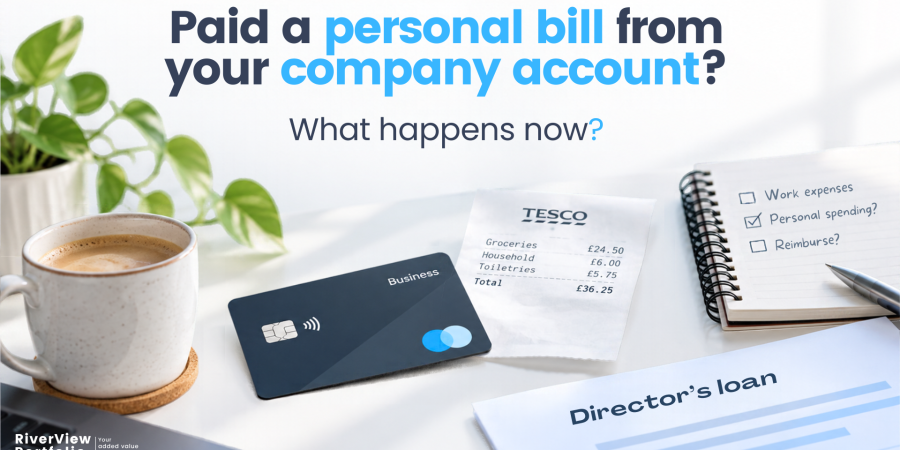
I Paid a Personal Bill From My Company Account. What Happens Now?
Accidentally paid for the weekly shop, a personal subscription or another private expense with your company card? It does not automatically become a business expense just because the company paid for it.
By RiverView Portfolio · Reviewed 12 October 2026
Quick answer: I used my company card for something personal. What should I do?
Do not panic, but do not simply put it through the accounts as a business expense either.
If the purchase was genuinely personal, it will normally need to be separated from the company’s allowable business costs and recorded correctly.
For an owner-director, that can mean charging the amount to the director’s loan account and repaying the company. In other circumstances, salary, benefits or dividend rules may need to be considered instead.
The correct answer depends on what the payment was, whether the company is actually bearing the cost and what other transactions already sit in your director’s loan account.
Can I use my limited company card for personal purchases?
You should generally keep personal spending separate from company spending. If you do use company money personally, the transaction still needs to be identified and recorded correctly.
A limited company is legally separate from you as an individual.
That means money in the company’s bank account is company money, even where you own all of the shares and are its only director.
HMRC’s director’s loan guidance specifically says that a director’s loan account should record cash withdrawals and personal expenses paid with company money.
Read the Insolvency Service fact sheet on director’s loan accounts.
I accidentally used my company card for a personal purchase. What should I do?
Identify the transaction, record it separately from normal business expenses and decide the correct treatment as soon as possible.
A one-off mistake is usually much easier to deal with when it is spotted quickly.
-
Identify exactly what was purchased.
Keep the receipt or transaction information and confirm whether there was any genuine business element. -
Do not categorise a private purchase as a normal business cost.
The bookkeeping should reflect what actually happened. -
Check your director’s loan account.
If the company has paid a personal cost for you, the amount may need to be debited to that account. -
Repay the company where appropriate.
If the amount represents money you owe the company, putting the money back can clear or reduce the balance. -
Keep evidence of the correction.
The original transaction and the repayment should both be identifiable in the accounting records.
Does a personal expense paid by my company become a director’s loan?
It often can. If the company pays a personal expense for you and the cost is not salary, a dividend, a genuine business expense or another valid company payment, it may be charged to your director’s loan account.
A director’s loan account tracks money moving between you and the company.
If the company already owes you money because you have personally funded business costs or lent money to the company, a private purchase might simply reduce that credit balance.
If there is no credit balance available, the purchase can instead increase the amount you owe the company.
GOV.UK defines a director’s loan as company money received by a director that is not salary, a dividend, expense repayment or repayment of money previously lent to the company.
Can I just put the personal purchase through as a business expense?
No, not simply because the company paid for it. A normal revenue expense generally needs a genuine business purpose before it can be deducted when calculating taxable company profit.
HMRC describes this through the “wholly and exclusively” principle.
Broadly, an expense can normally be deducted from trading profits only where it is incurred wholly and exclusively for the purposes of the trade, subject to specific rules and exceptions.
That means your personal supermarket shop, private holiday or personal household bill does not become deductible just because it appeared on the business bank statement.
Read HMRC’s guidance on company expenses you can deduct before Corporation Tax.
What if the purchase was partly business and partly personal?
Sometimes the identifiable business element can be separated from the private element. The answer depends on the type of expense and whether a genuine business proportion can be established.
HMRC guidance recognises that certain costs can have identifiable business and private elements.
Where the elements can genuinely be separated, the business proportion may potentially qualify even though the private proportion does not.
One bill, two uses.
Suppose a cost genuinely relates 60% to business use and 40% to private use, and the rules for that particular expense allow an identifiable apportionment.
The relevant business element may potentially be treated differently from the private 40%.
That does not mean an arbitrary percentage can be chosen. The split needs to be reasonable and supported by the facts.
HMRC’s technical guidance explains the principle of apportioning identifiable business expenditure.
Can my company reclaim VAT on a personal purchase?
Not on something that is wholly for personal use. If an item has both business and private use, only the qualifying business proportion of VAT may generally be recoverable.
This is another reason why private transactions should not simply be posted into the accounts as normal business costs.
GOV.UK says a VAT-registered business can reclaim VAT on purchases used for the business, but cannot reclaim VAT on something that is solely for personal use.
Where something has mixed use, records should support the business proportion claimed.
Read the official guidance on reclaiming VAT on business expenses.
Do I have to pay the personal expense back to my company?
If the personal expense has been charged to your director’s loan account and leaves you owing money to the company, repayment is one straightforward way of clearing that amount.
Paying the company back restores the cash and reduces the amount outstanding on the loan account.
The bookkeeping should show both sides clearly: the original personal purchase and the money subsequently repaid to the company.
You accidentally spend £240 on the company card.
You use the company card for a £240 entirely personal purchase.
The purchase is not treated as an allowable business expense and no VAT is claimed as business input tax.
The £240 is instead recorded against your director’s loan account.
You transfer £240 from your personal bank account back to the company shortly afterwards.
On these simplified facts, the repayment clears the £240 movement on the loan account.
What if the company is going to pay my personal bill and I am not repaying it?
That can move the issue away from a simple reimbursed director’s loan and into employment income or benefit rules.
HMRC has specific rules where an employer pays an employee’s or director’s personal bills.
The reporting and National Insurance treatment can depend on who arranged the goods or services, who contracted with the supplier and who actually paid.
For example, HMRC says that where an employee arranges goods or services but the employer pays the supplier directly, the cost can need to be reported and can attract National Insurance.
If the company is deliberately bearing a private cost, do not assume the answer is simply to leave it sitting in “expenses”.
Read the HMRC guidance on personal bills paid by an employer.
Can I just treat the personal purchase as a dividend instead?
Do not retrospectively call a payment a dividend simply because that produces a more convenient answer. A valid dividend needs to meet the normal company-law and accounting requirements.
Your company needs sufficient profits available for distribution before it can pay a valid dividend.
The dividend also needs to be properly declared and documented.
Where those conditions are genuinely met, a valid dividend can potentially be credited to a director’s loan account, which may reduce an amount owed to the company.
But that is different from pretending the original supermarket shop or personal bill was itself a business expense.
GOV.UK explains the rules for salary, dividends and director’s loans.
Can I put the personal expense through payroll instead?
Potentially, where the payment genuinely forms part of remuneration, but PAYE and National Insurance consequences may then apply.
HMRC recognises that payments or expenditure made for the benefit of a director can, in some circumstances, form part of their remuneration.
That does not mean every mistaken card transaction can simply be labelled salary after the event.
The director’s entitlement, payroll treatment, timing and supporting records all matter.
If remuneration is the correct treatment, it needs to be dealt with as remuneration rather than disguised as an ordinary business expense.
What if my limited company pays my personal tax bill?
A personal tax liability is not automatically a company expense simply because the company pays it. Separate tax and reporting rules can apply where a company settles tax on behalf of a director.
This is an area where the exact circumstances matter.
HMRC has specific guidance for situations where an employer pays Income Tax on behalf of a company director, including potential benefit and National Insurance consequences.
Read: HMRC guidance on Income Tax paid on a director’s behalf.
What if I have been using the company account for personal spending for months?
Review the transactions individually rather than treating the bank statement as one lump sum. Repeated private expenditure can build a significant director’s loan balance surprisingly quickly.
Go back through the company bank and card transactions and separate:
- genuine business expenditure;
- mixed-use expenditure;
- private expenditure;
- valid dividends;
- salary or remuneration;
- repayments of money the company owed you; and
- amounts that belong in the director’s loan account.
Once the loan account is reconstructed, you can see whether you actually owe the company money and how large the outstanding balance is.
What happens if personal spending pushes my director’s loan over £10,000?
Additional beneficial-loan rules can become relevant once the appropriate loan balance exceeds £10,000.
This is why repeated small personal purchases should not simply be ignored because each individual transaction looks insignificant.
£100 here, £300 there and a few larger bills can build into a substantial overdrawn balance.
Where the relevant loan exceeds £10,000, benefit-in-kind and reporting consequences may need to be considered.
GOV.UK provides guidance on beneficial loans provided to employees and directors.
Can personal expenses also lead to Section 455 tax?
Yes, potentially. If private expenditure contributes to an overdrawn director’s loan that remains outstanding beyond the relevant deadline, Section 455 can become relevant.
For relevant loans made on or after 6 April 2026, the Section 455 rate is 35.75%.
The relevant charge can arise where a qualifying loan to a participator remains outstanding beyond the normal nine-month-and-one-day point after the end of the company’s accounting period.
HMRC’s technical guidance confirms that the Section 455 rate increased to 35.75% from 6 April 2026.
Is company money basically my money if I own the business?
No. A limited company is a separate legal entity, so money held by the company should not be treated as your personal current account.
This is one of the most useful habits for an owner-director to establish early.
The fact that you own the company does not mean every pound in its bank account can be spent personally without tax or accounting consequences.
Before taking company money personally, first work out what the company needs for tax, normal costs and future plans.
Our guide Should I Leave Money in My Limited Company or Take It Out? explains how to identify what is genuinely surplus.
How can I stop mixing personal and company spending?
The easiest solution is procedural: make it harder to use the wrong account in the first place.
Separate the cards.
Keep the company card visually and physically separate from your personal bank cards where possible.
Check digital wallets.
Apple Pay, Google Pay and saved browser cards make it very easy to choose the wrong account without noticing.
Review transactions regularly.
Monthly bookkeeping can catch a mistaken transaction long before the year-end accounts are prepared.
Record the reason for transfers.
Know whether money is salary, dividend, expense reimbursement, loan repayment or a director’s loan before moving it.
Our bookkeeping support can help keep company transactions current and make unusual or private expenditure easier to identify.

Used the company account personally?
Dan Farthing · Managing Director
A mistaken personal purchase on the company card does not automatically mean you have created a major tax problem.
The important thing is to identify what happened, record it correctly and understand what the wider director’s loan account looks like rather than simply leaving the transaction buried in expenses.
Talk to Dan and the RVP teamSo, what should I do if I paid a personal bill from my company account?
First establish whether the cost was genuinely personal, business-related or mixed. Then record the transaction according to what actually happened.
If it was wholly personal, do not simply claim it as an ordinary company expense.
For an owner-director, the amount may need to go through the director’s loan account and be repaid.
If the company is intentionally bearing the personal cost, remuneration or benefit rules may instead need to be considered.
And if private spending has already built up into a larger overdrawn director’s loan, check the £10,000 beneficial-loan rules and the Section 455 position rather than waiting until the year-end accounts are complete.
Personal transactions mixed into your company accounts?
We can review the transactions, reconstruct your director’s loan account where needed and help you understand what should be repaid, reclassified or dealt with through the appropriate tax treatment.
Talk to RiverView PortfolioPersonal expenses paid from a company account: frequently asked questions.
I accidentally used my company card for a personal purchase. Is that a problem?
A one-off mistake can usually be dealt with by identifying the private transaction and recording it correctly. For a director, that may mean charging it to the director’s loan account and repaying the company rather than claiming it as a business expense.
Can I pay personal expenses from my limited company?
Company money can physically be used to pay a personal cost, but that does not automatically make the cost a deductible business expense. The transaction needs the correct accounting and tax treatment, which may involve a director’s loan, remuneration or benefit rules.
Does a personal purchase go on my director’s loan account?
It often can where company money has paid a personal expense and the payment is not salary, a dividend, a genuine business expense or repayment of money the company already owed you.
Do I have to repay a personal expense paid by my company?
If the amount has been charged to your director’s loan account and means you owe money to the company, repaying the company is one way of reducing or clearing that balance.
Can I claim a personal purchase as a business expense because I used the company card?
No. The payment method does not determine whether an expense is allowable. A normal business deduction generally requires the cost to have a genuine business purpose and satisfy the relevant tax rules.
Can my company reclaim VAT on something I bought personally?
VAT cannot generally be reclaimed on something that is wholly for personal use. Where a purchase has both business and private use, the qualifying business proportion may be recoverable where the relevant conditions are met and records support the calculation.
Can I turn a personal company-card purchase into a dividend?
You should not simply relabel a private purchase as a dividend. A valid dividend requires sufficient profits available for distribution and the appropriate company records. A properly declared dividend can potentially be credited against a director’s loan account where the conditions are genuinely met.
What if my company pays my personal bills and I do not repay them?
Employment income or benefit rules may become relevant where the company deliberately bears a director’s personal costs. The reporting and National Insurance treatment can depend on how the goods or services were arranged and paid for.
What happens if my director’s loan goes over £10,000 because of personal spending?
Beneficial-loan rules may become relevant where the appropriate loan balance exceeds £10,000. Additional tax, reporting and National Insurance consequences may therefore need to be considered.
Can personal spending lead to Section 455 tax?
Potentially. If personal expenditure creates or increases an overdrawn director’s loan and a qualifying balance remains outstanding beyond the relevant deadline, Section 455 can apply. For relevant loans made on or after 6 April 2026, the rate is 35.75%.
What if I have been using my business account for personal expenses for months?
Review the transactions individually and reconstruct the director’s loan account where needed. Separate genuine business expenses, private costs, dividends, remuneration and repayments before deciding what the final balance and tax position are.