
Should My Limited Company Pay Into My Pension or Should I Take a Dividend?
If your company has surplus profits, taking another dividend is not your only option. An employer pension contribution can produce a very different tax result, but the money also becomes pension money rather than cash you can spend today.
By RiverView Portfolio · Reviewed 20 October 2026
Quick answer: pension contribution or dividend?
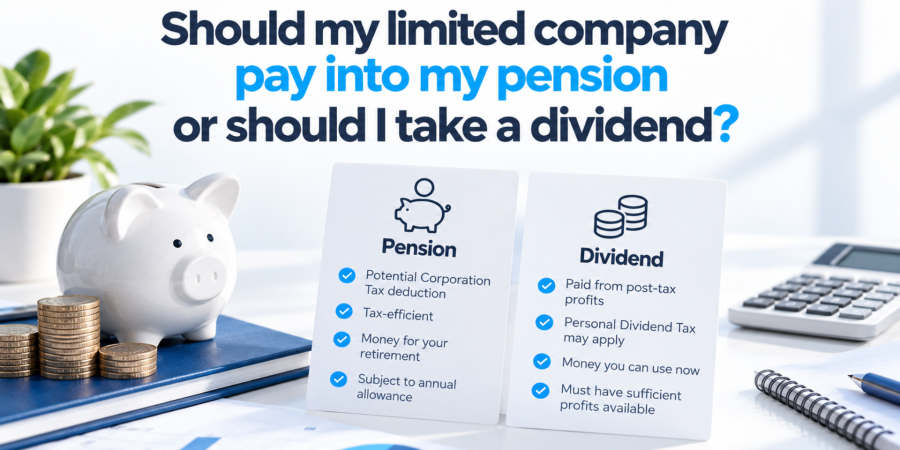
If you do not need the money personally now, a company pension contribution can be extremely tax-efficient.
A qualifying employer pension contribution can potentially reduce your company’s taxable profit, while you do not normally pay Income Tax on the contribution as earnings when it goes into a registered pension.
A dividend works differently. It is paid from post-Corporation-Tax profits and may then create personal Dividend Tax.
But a dividend gives you money you can use now. Pension money is normally locked away until you are old enough to access it.
So the question is not simply “which one pays less tax?” It is also about when you need the money, how much you already have in pensions and what your company can afford.
What is the difference between a company pension contribution and a dividend?
A company pension contribution moves company money into your pension. A dividend moves post-tax company profits into your personal hands.
| Question | Employer pension contribution | Dividend |
|---|---|---|
| Where does the money go? | Your registered pension | Your personal bank account |
| Corporation Tax deduction? | Potentially, if the contribution satisfies the relevant rules | No |
| Personal tax immediately? | Normally not taxed as earnings when the employer contributes to a registered scheme | Dividend Tax may be due |
| Accessible immediately? | No | Yes |
| Limited by company profits available for distribution? | Not under the dividend rules, although affordability and tax-relief rules still matter | Yes |
| Pension annual allowance relevant? | Yes | No |
Can my limited company pay directly into my pension?
Yes. A company can make an employer contribution directly into a registered pension scheme for a director or employee.
This is different from taking money from the company personally and then making an individual pension contribution.
With a genuine employer contribution, the company itself makes the payment into the pension.
HMRC confirms that employers can contribute to registered pension schemes and that employer contributions can potentially be deducted as a business expense when the relevant conditions are met.
Read HMRC’s overview of employer pension contributions.
Can a company pension contribution reduce Corporation Tax?
Potentially, yes. Employer pension contributions can normally be deducted when calculating taxable trading profits where they are incurred wholly and exclusively for the purposes of the trade.
That means a qualifying employer pension contribution can reduce the profits on which Corporation Tax is calculated.
HMRC describes pension contributions as part of the normal cost of employing staff and says contributions will generally be allowable where the normal wholly and exclusively test is satisfied.
This also applies to directors, although HMRC can consider the facts more closely where the person is both a controlling director and shareholder.
Read: HMRC guidance on employer pension contribution tax relief and HMRC guidance for controlling directors and shareholders.
How much Corporation Tax could a pension contribution save?
It depends on your company’s Corporation Tax position. The tax effect is not automatically 25% for every company.
The current Corporation Tax main rate is 25%.
Companies qualifying for the small profits rate can pay 19%, while Marginal Relief can apply between the relevant profit thresholds.
The £50,000 and £250,000 thresholds can also be reduced where a company has associated companies or a short accounting period.
Check the current Corporation Tax rates and thresholds.
How is taking a dividend different for tax?
A dividend is paid from profits after Corporation Tax and can then create a separate personal Dividend Tax liability.
Dividends are not an allowable company expense for Corporation Tax.
Your company first needs sufficient profits available for distribution.
Once a valid dividend is paid to you, the personal tax rate depends on your total income for the tax year.
For 2026/27, the Dividend Allowance is £500.
| 2026/27 band | Dividend rate above available allowance |
|---|---|
| Basic rate | 10.75% |
| Higher rate | 35.75% |
| Additional rate | 39.35% |
See the current GOV.UK Dividend Tax guidance.
Example: £10,000 pension contribution vs £10,000 company profit
What happens to £10,000?
Imagine your company has an additional £10,000 of profit before deciding whether to make a pension contribution or eventually distribute available post-tax profit as a dividend.
Assume, purely for illustration, that the company is paying Corporation Tax at the 25% main rate and that a £10,000 employer pension contribution is fully deductible.
Pension route: the company pays £10,000 directly into the pension. If the full £10,000 qualifies as a deduction, that contribution reduces taxable company profit by £10,000.
In this simplified example, the Corporation Tax difference associated with that £10,000 deduction would be £2,500.
The full £10,000 is now inside the pension, subject to the pension rules and your available annual allowance.
Dividend route: if that same £10,000 remains taxable at 25%, £2,500 of Corporation Tax would leave £7,500 of post-tax profit before considering whether it can lawfully be distributed.
If the full £7,500 were then paid as a dividend and your £500 Dividend Allowance had already been used, the personal Dividend Tax on that £7,500 would be approximately:
- £806.25 at 10.75%;
- £2,681.25 at 35.75%; or
- £2,951.25 at 39.35%.
That would leave approximately £6,693.75, £4,818.75 or £4,548.75 respectively as spendable cash from the dividend in this simplified example.
Can my company pay a large pension contribution if I only take a small salary?
Potentially, yes. Employer pension contributions do not use the same earnings-based tax-relief limit that applies to an individual’s own pension contributions.
This is particularly relevant to company directors who deliberately take a relatively modest salary.
Personal pension contributions that receive individual tax relief are generally restricted by relevant UK earnings rules.
Employer contributions are treated differently.
HMRC states that there is no set equivalent limit on the amount of tax relief an employer may receive on employer contributions.
However, that does not mean the company can simply pay an unlimited amount into your pension without consequences.
The employer contribution still needs to satisfy the company tax rules and it counts towards your pension annual allowance.
How much can my limited company pay into my pension?
There is no single figure that is safe for every director. Your pension annual allowance, previous pension contributions, income and whether special restrictions apply all need to be checked.
The standard pension annual allowance for 2026/27 is £60,000.
Employer contributions count towards that allowance, together with other pension input for the tax year.
If pension savings exceed your available annual allowance, an Annual Allowance tax charge can arise.
Check HMRC’s current pension scheme rates and allowances.
Can I use unused pension allowance from previous years?
Potentially. Carry forward can allow unused annual allowance from the previous three tax years to increase the amount available in the current year where the conditions are satisfied.
For 2026/27, that can potentially involve unused allowance from:
- 2025/26;
- 2024/25; and
- 2023/24.
Carry forward is one reason a company may sometimes be able to make a pension contribution above the standard £60,000 annual allowance without an Annual Allowance charge.
But the calculation needs to take account of pension input already made in those years and whether other restrictions apply.
Read GOV.UK’s annual allowance and carry-forward guidance.
What if I am a high earner?
Your £60,000 annual allowance can potentially be reduced under the tapered annual allowance rules.
For 2026/27, the relevant thresholds include:
- £200,000 threshold income; and
- £260,000 adjusted income.
Where the tapered annual allowance applies, the standard allowance can reduce to a minimum of £10,000.
Employer pension contributions themselves can also affect the adjusted-income calculation.
See HMRC’s tapered annual allowance guidance.
What if I have already taken money from my pension?
If you have flexibly accessed certain defined-contribution pension benefits, the Money Purchase Annual Allowance may apply.
For 2026/27, the Money Purchase Annual Allowance is £10,000.
This can significantly change the amount that can be contributed to money purchase pensions without an Annual Allowance charge.
It is therefore important not to assume that because the standard annual allowance is £60,000, you personally have £60,000 available.
What is the biggest disadvantage of choosing a pension instead of a dividend?
Access. A dividend becomes personal cash you can use now. A pension contribution is money set aside for retirement.
The normal minimum pension age is currently 55 for most people.
From 6 April 2028, it is due to rise to 57, although protected pension ages and other exceptions can apply.
HMRC explains the normal minimum pension age rules.
When might a company pension contribution make more sense?
It can be particularly attractive where the company has genuine surplus cash and you are happy to move that money into long-term retirement savings.
You do not need the cash now.
If the money is genuinely for retirement rather than current spending, losing immediate access may not be a problem.
You have pension allowance available.
The standard annual allowance, carry forward and any taper or MPAA position should be checked first.
The contribution qualifies for company tax relief.
A qualifying employer contribution can reduce taxable company profit.
You would otherwise face significant Dividend Tax.
The personal tax cost of extracting another dividend can become more significant once your other income pushes dividends into higher bands.
When might taking a dividend make more sense?
A dividend may be more appropriate where your priority is having personal access to the money now.
For example, you might need the money for:
- normal household spending;
- a house deposit;
- personal debt;
- investment outside a pension;
- a major planned purchase; or
- building your personal emergency fund.
There is little value in maximising pension contributions purely for tax reasons if doing so leaves you personally short of accessible cash.
Do I actually have to choose between a pension and a dividend?
No. For many directors, the sensible answer is a combination rather than an all-or-nothing decision.
You might take enough salary and dividends to meet your current personal requirements while directing part of genuinely surplus company cash into a pension.
Some profit might also simply remain inside the company rather than being extracted at all.
Should I make a pension contribution just to reduce Corporation Tax?
Not without looking at the company’s cash position first. Tax relief does not make the contribution free.
If the company contributes £20,000 into a pension, £20,000 of cash still leaves the company.
Before paying it, check what cash is needed for:
- Corporation Tax;
- VAT;
- PAYE and National Insurance;
- staff and suppliers;
- loan repayments;
- future investment; and
- a sensible operating buffer.
What should I check before choosing pension contributions or dividends?
-
Work out what the company can genuinely afford.
Separate available cash from money needed for taxes, costs and future commitments. -
Decide whether you need personal access.
Money in a pension is fundamentally different from cash paid to your personal bank account. -
Check your pension allowance.
Include employer contributions and other pension inputs already made during the tax year. -
Check for tapering or the MPAA.
Do not assume the standard £60,000 allowance automatically applies. -
Check the company’s Corporation Tax position.
The tax saving depends on the company’s actual taxable profits and applicable rate. -
Check your personal Dividend Tax position.
Your other income determines where additional dividends sit within your tax bands. -
Look beyond one tax year.
Consider retirement planning, future extraction, company investment and the amount of accessible personal cash you want to retain.
What if I have already taken the money out as a dividend?
Do not assume you can simply reverse history and call an existing dividend a company pension contribution.
The treatment depends on what was actually declared, paid and recorded at the time.
If money has already left the company without the correct basis, there may also be director’s loan issues to consider.
Read: What Happens If I Take Too Much Money Out of My Limited Company?
Why do up-to-date company figures matter?
Because neither dividends nor pension planning should be based purely on what happens to be sitting in the bank account.
Current bookkeeping helps you understand:
- actual company profit;
- Corporation Tax exposure;
- cash already committed elsewhere;
- profits available for dividends; and
- whether the business can comfortably fund a pension contribution.
Our bookkeeping support can help keep those numbers current rather than waiting until the year-end accounts to find out what happened.

Dividend or pension?
Dan Farthing · Managing Director
The most tax-efficient option on paper is not necessarily the right answer for you or the company.
We can look at the company profits, cash position, your current income and the amount you actually need personally before deciding how much should be taken, retained or directed towards retirement.
Talk to Dan and the RVP teamSo, should my company pay into my pension or should I take a dividend?
If you need the money personally now, a pension contribution may not solve the problem. If the money is genuinely surplus and intended for retirement, an employer pension contribution can be considerably more tax-efficient than extracting the same company profit as a dividend.
The pension route can potentially reduce taxable company profit and avoid an immediate personal Income Tax charge on the employer contribution.
The dividend route normally starts with profits that have already been subject to Corporation Tax, with Dividend Tax potentially payable personally afterwards.
But dividends give you accessible cash. Pension contributions do not.
You also need to check the annual allowance, carry forward, tapered allowance and MPAA where relevant before making larger pension contributions.
In practice, many directors will not need to choose one exclusively. A combination of salary, dividends, pension contributions and retained company profit can often produce a more balanced result.
Deciding what to do with surplus company profit?
We can help you compare dividends, employer pension contributions and leaving money inside the company using your actual company figures and personal position.
Talk to RiverView PortfolioCompany pension contributions vs dividends: frequently asked questions.
Is it better to pay into a pension from my limited company or take a dividend?
It depends on what you need the money for. A qualifying employer pension contribution can potentially reduce taxable company profit and does not normally create an immediate Income Tax charge as earnings. A dividend gives you accessible personal cash but is paid from post-Corporation-Tax profit and can create Dividend Tax.
Can my limited company pay directly into my personal pension?
Yes. An employer can contribute directly to a registered pension scheme for a director or employee, subject to the pension scheme accepting employer contributions and the relevant tax and pension rules.
Are limited company pension contributions tax deductible?
Employer contributions can potentially be deducted when calculating company profits if they satisfy the relevant wholly-and-exclusively test. The circumstances of the company and director still matter.
Can my company pay £60,000 into my pension?
Potentially, but £60,000 is the standard pension annual allowance for 2026/27 rather than an automatic company contribution limit. Other pension input, tapering, the Money Purchase Annual Allowance and carry forward can change the amount available.
Can my company pay more than £60,000 into my pension?
It may be possible where unused annual allowance can be carried forward from previous tax years, but the calculation depends on previous pension input and whether other restrictions apply.
Can my company make a large pension contribution if I only take a small salary?
Employer contributions do not use the same relevant earnings limit that applies to tax relief on an individual’s own contributions. However, the company tax rules and the member’s pension annual allowance still need to be considered.
Do employer pension contributions count towards the annual allowance?
Yes. Employer contributions count towards the member’s pension input for annual allowance purposes.
What is the pension annual allowance for 2026/27?
The standard annual allowance for 2026/27 is £60,000. The amount available to an individual can be different where the tapered annual allowance or Money Purchase Annual Allowance applies.
What is the Money Purchase Annual Allowance in 2026/27?
The Money Purchase Annual Allowance is £10,000 for 2026/27. It can apply after certain flexible access to money purchase pension benefits.
Can I take a dividend and make a company pension contribution in the same year?
Yes. They are not mutually exclusive. A director can potentially receive salary and dividends while the company also makes employer pension contributions, provided each payment satisfies its own rules.
Is a pension contribution always better than a dividend for tax?
No. Although employer pension contributions can be very tax-efficient, the money is intended for retirement and cannot normally be accessed immediately. Your need for personal cash, pension allowances, company cash flow and future plans all matter.
Should I empty surplus company cash into my pension before year end?
Not simply to obtain tax relief. First check the company’s Corporation Tax, VAT, payroll, supplier commitments, future investment requirements and appropriate cash reserve, as well as your available pension allowance.