
Quick answer.
HMRC has launched a consultation on more timely payment of Self Assessment tax. This does not prove that Making Tax Digital was designed to collect tax earlier, and HMRC states the proposals are separate from MTD. However, both measures fit into a wider shift towards more digital, more regular and more real-time tax administration.
Making Tax Digital has often been discussed as a record-keeping and reporting change.
For businesses, landlords and the self-employed, the focus has been on using compatible software, keeping digital records and submitting information to HMRC more regularly.
However, a new government consultation has raised a slightly different question:
Is the UK tax system now moving from digital reporting towards more regular tax collection too?
Many on social media are speculating that Making Tax Digital was secretly created for that purpose. There is no verified evidence for that claim. However, the latest proposals do show the direction of travel of HMRC and the Government to look at ways to bring tax payments closer to the point at which income is earned.
What has been announced?
A new consultation.
The Government has launched a consultation on Timely Payments in Income Tax Self Assessment.
More regular payments.
The consultation explores whether some taxpayers should begin paying their Self Assessment tax more regularly instead of relying mainly on the current January and July payment cycle.
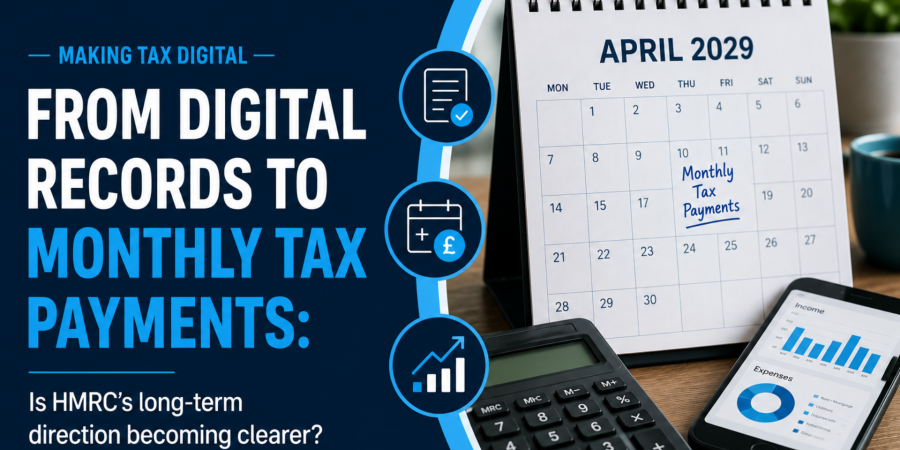
PAYE from April 2029.
One proposal would allow some taxpayers who receive income through PAYE to have more of their Self Assessment tax collected throughout the year via PAYE from April 2029.
The consultation also considers whether more timely payment arrangements could eventually apply to other Self Assessment taxpayers.
It is important to remember that these are proposals only. No final decisions have been made.
Where does Making Tax Digital fit in?
Making Tax Digital for Income Tax is already changing how many sole traders and landlords report their income and expenses.
Instead of preparing everything once a year, affected taxpayers will be required to keep digital records and submit quarterly updates using compatible software.
This gives HMRC more regular information about taxable income.
Important distinction
The Government’s own factsheet says the new Timely Payments proposals are “separate, but complementary to Making Tax Digital.”
That wording is significant.
It means we should not say that Making Tax Digital was introduced to collect tax earlier. HMRC does not make that claim. However, it is fair to observe that both initiatives point towards a tax system that is becoming:
- More digital
- More frequent
- More real-time
A wider direction of travel.
Looking at recent reforms together, a pattern begins to emerge.
Digital records.
Making Tax Digital encourages digital record keeping.
Quarterly updates.
Quarterly updates provide HMRC with more regular information.
Tax payments.
The new consultation considers whether tax payments themselves should also become more regular.
Each reform is different, but together they suggest a move away from annual administration towards a more continuous tax system.
Whether that ultimately becomes Government policy remains to be seen, but it is a direction worth paying attention to.
Why this matters for businesses.
For many business owners, Self Assessment is not difficult because of the calculation.
It is difficult because of the timing.
Potential benefit.
More regular tax payments could help some taxpayers budget more effectively by spreading payments across the year.
Potential concern.
Others may be concerned about losing flexibility, particularly where income fluctuates from month to month.
Businesses whose profits vary throughout the year will understandably want reassurance that any future system can respond accurately to changing circumstances.
These are exactly the sorts of issues the consultation is seeking views on.
What could happen from April 2029?
Under the proposals, some taxpayers who already pay tax through PAYE could also have estimated Self Assessment liabilities collected during the year through their tax code.
Rather than waiting until January and July to make payments, some tax could be collected gradually as income is earned.
There would still need to be a year-end reconciliation because estimated tax payments will not always match a taxpayer’s final liability.
The consultation also explores whether similar principles could be extended more widely across Self Assessment in the future.
What do we know for certain?
We know that:
- HMRC has launched a consultation on more timely payment of Income Tax Self Assessment.
- Some PAYE taxpayers could begin paying more of their Self Assessment tax through PAYE from April 2029.
- The Government is also exploring more regular payment options for other Self Assessment taxpayers.
- HMRC states that these proposals are separate from, but complementary to, Making Tax Digital.
- The consultation has not yet become law.
So, is this the real reason behind Making Tax Digital?
Making Tax Digital is a reporting reform.
The Timely Payments consultation is a payment reform.
Together, they appear to form part of a broader move towards a more digital, more regular and more real-time tax system.
So whilst HMRC may say they aren’t connected, the synergies appear to be pretty apparent.
What should businesses do now?
There is no immediate action required in relation to the consultation itself other than to engage with the process if there is opportunity.
Whilst no one likes more tasks being brought to their plate, there are some good habits that businesses should be looking to do which include:
Regardless of whether the proposals are introduced in their current form, good bookkeeping and up-to-date financial records will leave businesses in a much stronger position for future changes.
Need help getting ready for MTD?
If you are unsure whether Making Tax Digital will apply to your business, or you want to strengthen your bookkeeping processes before future changes arrive, RiverView Portfolio can help.
Useful official guidance.
You can read the Government consultation and factsheet here:
FAQs.
Does this mean Self Assessment tax will definitely be paid monthly?
No. The current position is that the Government has launched a consultation. Some PAYE taxpayers could pay more of their Self Assessment tax in-year through PAYE from April 2029, but the wider position for other Self Assessment taxpayers is still being explored.
Is Making Tax Digital being used to collect tax earlier?
HMRC has not said that Making Tax Digital was introduced for that reason. Making Tax Digital is a reporting reform. The Timely Payments consultation is a payment reform. The Government’s wording says the proposals are separate, but complementary to Making Tax Digital.
Who could be affected from April 2029?
The proposal focuses on Income Tax Self Assessment taxpayers with sufficient PAYE income. The consultation also explores whether more timely payment arrangements could be extended to other Self Assessment taxpayers in future.
What should businesses do now?
There is no immediate action required because the consultation has not yet become law. However, businesses should keep bookkeeping records up to date, use compatible accounting software where required, understand whether MTD for Income Tax applies to them, and set money aside regularly for tax liabilities.