
Quick answer
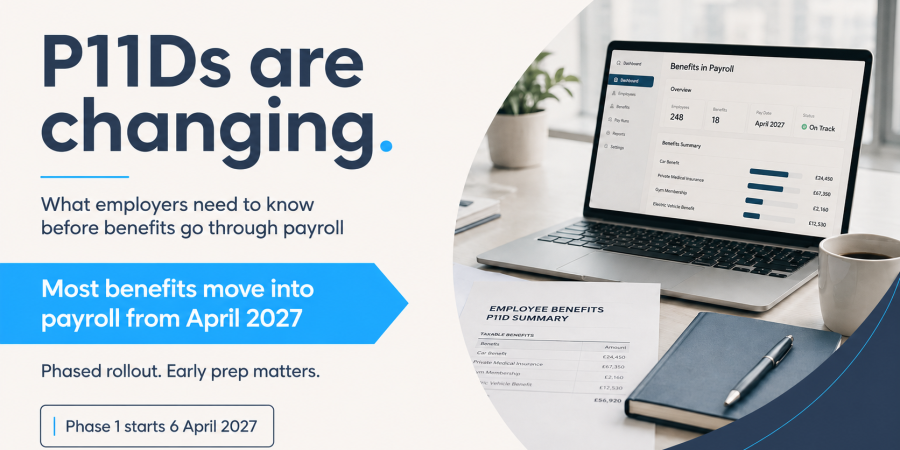
P11Ds are changing because HMRC is moving towards mandatory real-time reporting of many benefits in kind and taxable expenses through payroll. Phase 1 starts on 6 April 2027 and includes company cars, car fuel, vans, van fuel and employer-provided medical benefits. Employers should review their benefits, payroll software, data collection and employee communications now.
For many employers, P11Ds have traditionally been a year-end task. Benefits are reviewed after the tax year, forms are prepared, Class 1A National Insurance is calculated, and employees receive information about taxable benefits they received during the year.
That process is now changing. HMRC is moving towards reporting many benefits in kind and taxable expenses through payroll software, using real-time information. In practical terms, benefits that may previously have been dealt with after the end of the tax year will increasingly need to be handled during the year.
This is not just a technical payroll change. It affects how employers collect information, how benefits are valued, how payroll is run, how employees understand deductions, and how quickly errors need to be identified.
Key points for employers
Phase 1 starts on 6 April 2027
The first phase covers company cars, car fuel, vans, van fuel and employer-provided medical benefits.
Real-time reporting becomes more important
Many benefits will need to be reported through payroll using FPS and RTI processes.
Employee communication matters
Employees may see the tax effect of some benefits during the year rather than waiting for a later adjustment.
Preparation should start now
Employers should check benefit data, payroll software, processes and responsibilities before April 2027.
Why this matters
P11Ds are moving from a year-end task to a payroll process
The biggest change is not simply the removal of a familiar form. The bigger issue is timing.
Once benefits are handled through payroll, employers need timely and accurate benefit information during the year. That can be a major shift for businesses that currently only review benefits when the P11D deadline comes around.
What is changing with P11Ds?
HMRC has published interim guidance on the move to mandatory payrolling of benefits in kind and taxable expenses. The rules are being phased in, with the first phase beginning from 6 April 2027 and a second phase due to start from 6 April 2028.
Under the new approach, many benefits will be reported through payroll software using the Full Payment Submission. This is the same general process employers already use to report salary and other employee pay details to HMRC.
For most benefits in kind and taxable expenses, HMRC says Income Tax and Class 1A National Insurance contributions will need to be reported through Real Time Information and paid in real time from April 2027.
Which benefits are included from April 2027?
From 6 April 2027, phase 1 of mandatory payrolling is expected to apply to:
- company cars;
- car fuel;
- vans;
- van fuel; and
- employer-provided medical benefits.
Other categories are due to follow later as part of the wider phased rollout. Employers should avoid assuming that a benefit is unaffected simply because it is not included in phase 1.
Important: this is interim guidance
HMRC’s published guidance is designed to help employers, agents, software developers and benefit providers prepare. However, some detail may still develop as legislation and technical guidance are finalised.
That means employers should prepare early, but avoid making final technical decisions without checking the latest guidance, payroll software updates and professional advice.
Why does this create extra work for employers?
A P11D process can feel separate from payroll because it happens after the tax year. Mandatory payrolling brings the issue into the regular payroll cycle.
That means employers may need to know, during the year:
- which employees receive which benefits;
- when benefits start or stop;
- the taxable value of each benefit;
- whether benefit data is accurate enough for payroll reporting;
- how changes will affect employee tax deductions; and
- whether payroll software and internal processes can handle the reporting.
For employers with simple benefits, this may be manageable with some early planning. For employers with company cars, medical cover, salary sacrifice arrangements, multiple payrolls or changing employee benefits, the process may need more careful review.
What should employers do now?
April 2027 may sound a long way off, but payroll changes are rarely something to leave until the last minute. Employers should use the time now to understand what benefits they provide and how the information is currently collected.
Do employers need to register?
HMRC says employers will not need to register in order to payroll benefits in kind from April 2027. However, employers that want to voluntarily payroll employment-related loans and accommodation will need to register to do so.
The service to register for voluntarily payrolling loans and accommodation in the 2027 to 2028 tax year is expected to go live in November 2026. Employers should check the latest position before taking action.
What happens if benefit information is not ready?
HMRC has indicated that penalties will not be charged where a reasonable estimate of the taxable value is used because sufficient information is not available. However, that should not be treated as a reason to be relaxed about the process.
Estimates can still create problems. Employees may face unexpected adjustments later, payroll records may need correcting, and finance teams may spend more time dealing with queries.
The better approach is to build a process that collects benefit data accurately and on time wherever possible.
How RiverView Portfolio can help
This is exactly the kind of change that can catch employers out because it sits between payroll, tax, benefits and employee communication.
At RiverView Portfolio, we support employers with payroll, accounts, tax and practical business advice. We can help you review:
- which benefits you currently provide;
- whether any phase 1 benefits are relevant to your business;
- how your payroll processes will need to change;
- whether your software is ready;
- what information needs to be collected during the year; and
- how to communicate the changes clearly to employees.
The goal is simple: fewer payroll headaches, fewer surprises and a smoother transition when the new rules take effect.
Do not wait until April 2027 to review your payroll
If your business provides employee benefits, now is the time to check what is changing and whether your payroll processes are ready.
Useful links
For further reading, you may find the following resources useful:
P11D and payrolling benefits FAQs
Are P11Ds being abolished?
The P11D process is changing because many benefits in kind and taxable expenses are moving towards real-time payroll reporting. The change is being phased in, so employers should check which benefits are affected and when.
When does mandatory payrolling of benefits start?
Phase 1 starts from 6 April 2027. HMRC says phase 2 will start from 6 April 2028 as part of the wider phased rollout.
Which benefits are included in phase 1?
Phase 1 is expected to include company cars, car fuel, vans, van fuel and employer-provided medical benefits.
Do employers need to register for mandatory payrolling?
HMRC says employers will not need to register in order to payroll benefits in kind from April 2027. However, voluntary payrolling of employment-related loans and accommodation will require registration.
What should employers do before April 2027?
Employers should review the benefits they provide, check payroll software and processes, agree who collects benefit data, and plan employee communications early.
Final thought
P11Ds are changing, but this should not be a panic exercise.
For employers, the smart move is to use the time now to review benefits, payroll software, data collection and communication. The earlier you prepare, the fewer problems you should face when benefits move into payroll.
“””
path = Path(“/mnt/data/rvp-p11ds-are-changing-blog-code.txt”)
path.write_text(html, encoding=”utf-8″)
print(path)
print(“length”, len(html))
print(“contains backticks:”, “`” in html)
print(“contains em dash:”, “—” in html)