
Quick answer
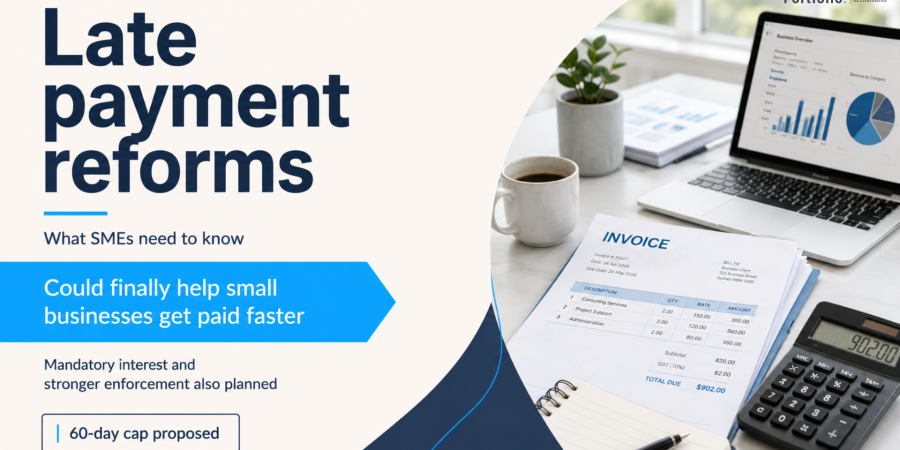
The government has introduced the Commercial Payments Bill, also referred to as the Small Business Protections Bill, to tackle poor payment practices. The proposed changes include a 60-day cap on payment terms, mandatory interest on late payments and stronger powers for the Small Business Commissioner. The measures are not all in force yet, but small businesses should use this as a prompt to tighten their invoicing, credit control and cashflow systems now.
Most business owners know the feeling. The work has been done. The invoice has been sent. The payment date has passed. Then the chasing begins.
That delay can cause real pressure. It affects wages, supplier payments, VAT bills, corporation tax planning, confidence and growth. In simple terms, late payment means a business can be profitable on paper but short of cash in the bank.
The government’s late payment reforms are designed to change that culture. For small businesses, the proposed changes could be helpful. However, they are not a substitute for strong systems, clear invoice terms and regular cashflow management.
Key points for small businesses
A 60-day cap is planned
The Bill proposes maximum payment terms of 60 days, with strictly limited exemptions.
Late payment interest would be mandatory
The reforms include mandatory interest on late payments at 8% above the Bank of England base rate.
The Small Business Commissioner gets stronger powers
The Commissioner would be able to investigate poor payment practices, adjudicate disputes and take enforcement action.
Cashflow systems still matter
Even with stronger rules, businesses need good records, timely invoicing and active credit control.
Why this matters
Late payments cost more than time
According to the government, late payments cost the UK economy £11 billion per year and contribute to 38 UK businesses closing every day.
Those are national figures, but the issue is felt locally by owners trying to pay staff, suppliers, rent, tax and themselves.
What are the late payment reforms?
The Commercial Payments Bill was introduced to Parliament in May 2026. Its purpose is to improve payment practices between businesses and help cash move through supply chains more reliably.
The main proposals include:
- A maximum payment term of 60 days, with strictly limited exemptions.
- Mandatory interest on late payments, set at 8% above the Bank of England base rate.
- A right to a fixed sum where a purchaser raises a dispute late or without enough information.
- Stronger powers for the Small Business Commissioner, including investigation, adjudication and enforcement powers.
- Action on construction retentions, including a proposed ban on deducting and withholding retention payments under construction contracts, with further consultation on timing.
The government has said there will be a lead-in time and transition period before the new powers come into force. It has also said the measures will not apply retrospectively, so existing payments, contracts and disputes will be judged according to the rules in place at the relevant time.
Important: this is not a reason to wait
The reforms may help small businesses, especially where larger customers impose long payment terms or delay payment after receiving goods or services.
However, late payment rules only help if your own processes are clear. If invoices are sent late, payment terms are vague, records are inconsistent or disputes are not documented properly, the business may still be left chasing money unnecessarily.
What should small businesses do now?
You do not need to overhaul everything overnight. Start with the basics that make payment easier, faster and harder to ignore.
Late payment is a management information issue too
A business can look healthy in its profit and loss account but still struggle because too much money is tied up in unpaid invoices.
That is why debtor reporting matters. A regular aged debtors report can show:
- which customers are paying late;
- how much cash is tied up in overdue invoices;
- whether payment delays are getting worse;
- whether certain customers need different terms; and
- whether the business needs to adjust its cashflow forecast.
Where your accountant can help
This is not just a legal or admin issue. Late payments affect the numbers your business is run on.
At RiverView Portfolio, we support businesses with accounts, tax, bookkeeping, payroll and business advice. In practical terms, that can mean helping you:
- keep accounting records up to date;
- use software more effectively;
- understand what is owed to the business;
- review cashflow alongside tax and payroll dates;
- spot pressure points earlier; and
- make better decisions from more reliable figures.
The aim is not just to file accounts at the end of the year. It is to give business owners clearer information throughout the year.
Do you know who owes your business money?
If late payments are putting pressure on your cashflow, now is a good time to review your invoicing, bookkeeping and debtor reporting systems.
Useful links
For further reading, you may find the following resources useful:
Late payment reforms FAQs
Are the late payment reforms already law?
The Commercial Payments Bill was introduced to Parliament in May 2026. The government has said there will be a lead-in time and transition period before the new powers come into force. Businesses should therefore treat the reforms as something to prepare for, not as a reason to assume every new measure already applies.
What is the proposed 60-day payment cap?
The Bill proposes maximum payment terms of 60 days, with strictly limited exemptions. The aim is to stop poor payment practices that leave small suppliers waiting too long to be paid.
Can small businesses charge interest on late payments?
Under current GOV.UK guidance, a business can claim interest and debt recovery costs if another business is late paying for goods or services. The proposed reforms include mandatory interest on late payments at 8% above the Bank of England base rate.
Will the late payment reforms fix cashflow problems?
They may help, but they will not replace good cashflow management. Small businesses still need clear terms, timely invoices, accurate records, active credit control and regular cashflow reviews.
How can RiverView Portfolio help with late payment and cashflow?
RiverView Portfolio can help business owners improve their bookkeeping, use accounting software more effectively, review debtor reports and understand cashflow alongside tax, VAT and payroll commitments.
Final thought
The late payment reforms are a positive step for small businesses, but the best protection is still preparation.
If you invoice promptly, track debts properly and understand your cashflow position, you are in a much stronger place, whatever the final shape of the new rules.